
In this blog, we explain ETL vs ELT in simple terms, highlight their differences, and show how Databricks fits into both patterns.
Modern companies collect data from many systems. This data comes from applications, sensors, databases, APIs, and sometimes even spreadsheets. To make this data useful for analytics and AI, it must be processed and transformed. This is where ETL and ELT play an important role.
ETL and ELT are two common ways to move and prepare data. The choice between them can affect cost, speed, data quality, and how well a company can adopt machine learning or AI. Databricks supports both ETL and ELT, but it does so in a modern way that takes advantage of cloud computing and the lakehouse architecture.
In this blog, we explain ETL vs ELT in simple terms, highlight their differences, and show how Databricks fits into both patterns.
What Is ETL
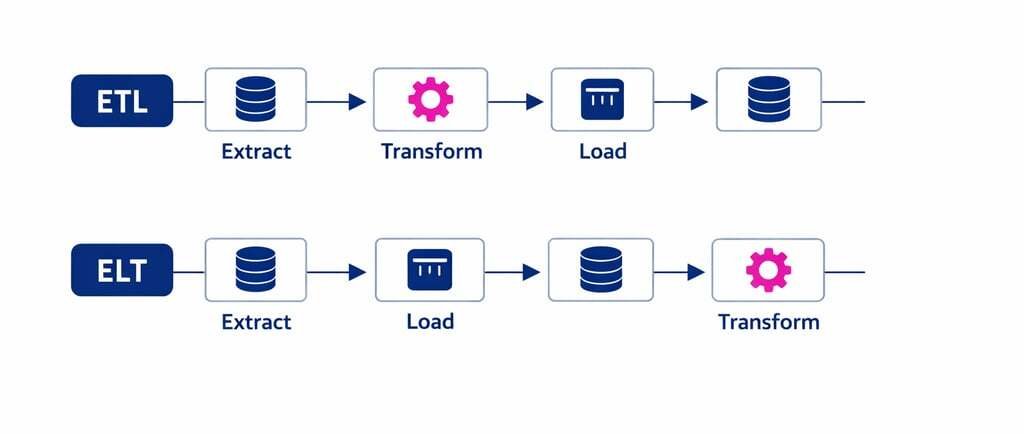
ETL stands for Extract, Transform, Load.
The steps are:
Extract data from source systems
Transform the data into a usable format
Load the data into the target system
ETL was the main pattern in traditional data warehouse systems. Transformations happened before loading to ensure the warehouse stored clean and structured data.
This made sense when compute power was limited and storage was expensive. Companies needed strong control before data entered the warehouse.
What Is ELT
ELT stands for Extract, Load, Transform.
The steps are:
Extract data from source systems
Load the data into the target system
Transform data inside the target system
ELT became popular with cloud data platforms because compute and storage became cheap and elastic. Instead of transforming data first, the platform can store raw data and transform it later.
ELT gives more flexibility and supports analytics, machine learning, and iterative workloads.
Key Differences Between ETL and ELT
The main difference is where and when transformations happen.
In ETL:
Transform early
Store only curated data
In ELT:
Load early
Transform later inside the platform
This choice changes how teams structure pipelines and manage data.
Why ELT Became Popular in Cloud Platforms
Cloud systems changed the economics of data. Storage became cheap. Compute became elastic. Users wanted more freedom to explore data.
ELT supports this model because raw data is available for many use cases. Different teams can apply their own transformations for reporting, operations, or AI.
ETL vs ELT in Databricks
Databricks supports both ETL and ELT, but its architecture is more aligned with ELT due to the lakehouse approach.
With Databricks, raw data is loaded into cloud storage, often in a Bronze layer. Transformations happen in Silver and Gold layers. This matches the ELT workflow.
However, Databricks also supports ETL for cases such as compliance, filtering, or sensitive data removal before storage.
Databricks and the Medallion Architecture
Databricks introduced the Medallion architecture to organize data transformations in layers:
Bronze: raw data
Silver: cleaned and structured data
Gold: refined, aggregated, or business ready data
This layered model matches ELT logic. Data is extracted and loaded into Bronze. Transformations happen within Databricks to create Silver and Gold.
This approach gives companies flexibility and supports machine learning, analytics, and real time use cases.
ETL Workloads on Databricks
Some ETL scenarios remain useful. Examples include:
Removing sensitive data before storage
Filtering noisy data from sensors
Applying strict transformations for compliance
Cleaning data from legacy systems
ETL pipelines may be built with tools such as:
Databricks Jobs
Spark Structured Streaming
Databricks Workflows
Azure Data Factory or AWS Glue for pre processing
In these cases, transformation happens before writing to the lake.
ELT Workloads on Databricks
Most companies use Databricks for ELT because it allows:
Faster iteration for analytics
Support for multiple transformations
Exploration and discovery
Machine learning preparation
Time travel and version control
Raw data enters the lake first and is transformed inside Delta Lake tables.
Delta Lake and Transformation Flexibility
Delta Lake plays an important role in ELT. It provides:
Transaction support
Schema enforcement
Time travel
Merge operations for CDC
Efficient storage
These features allow transformations to happen after loading without losing control or quality.
ETL vs ELT for Machine Learning
Machine learning workloads prefer ELT because:
Data scientists need raw data
Training data changes often
Feature engineering requires many transformations
Historical versions must be stored
ETL removes raw data too early, which limits ML flexibility.
ETL vs ELT for Business Intelligence
BI teams care about consistency and correctness. ELT helps because multiple curated data sets can be created from a single raw source.
However, strict BI warehouses sometimes still use ETL to enforce a single version of the truth.
Databricks supports both patterns, which gives BI teams choice.
ETL vs ELT for Real Time Scenarios
Sensor, IoT, and event driven data often works best with ELT. Raw events are ingested, then transformations add structure.
Energy companies, healthcare networks, and logistics operations use ELT to support:
Live dashboards
Operational decision systems
Predictive maintenance
Forecasting models
ETL can also work for real time but is less flexible.
Cost Considerations
Cloud economics make ELT attractive, but cost is still a factor.
ETL may reduce storage cost by discarding data early. ELT increases storage but reduces engineering cost and speeds development.
Databricks allows companies to control cost by using:
Cluster autoscaling
Spot pricing
Efficient file storage
Optimised Delta tables
Cost strategy depends on workload type.
Security Considerations
Security concerns affect ETL vs ELT choice.
For example:
If raw data contains sensitive fields
If compliance rules demand pre processing
If PII must be removed
ETL may be required to clean data before loading.
Unity Catalog and Delta sharing provide governance for ELT workloads on Databricks.
Performance Considerations
ELT can be faster for development because transformations use scalable compute. ETL performance often depends on external tools.
Databricks can scale transformations across many nodes, which improves speed.
Common Enterprise Scenarios
Here are common patterns companies follow:
Scenario 1: ETL for Compliance
Data filtered before storage for industries like healthcare or finance.
Scenario 2: ELT for Analytics
Raw data stored in Bronze for shared analytics.
Scenario 3: ELT for ML
Raw and historical data kept for feature engineering.
Scenario 4: Hybrid
Some fields cleaned with ETL, rest processed through ELT.
Databricks supports all four.
Choosing Between ETL and ELT
Business leaders should consider:
Data sensitivity
Workload type
Compliance needs
ML requirements
Speed to insight
Storage cost
Engineering resources
Companies building AI platforms should favor ELT for flexibility.
Databricks as a Unified Platform for ETL and ELT
One major advantage of Databricks is its unified architecture. It supports:
Batch processing
Streaming
BI analytics
Governance
Collaboration
This allows companies to avoid disconnected tools and duplicated data.
Why the Industry Is Moving to ELT
Several factors explain the move toward ELT:
Storage is cheap
Compute is scalable
AI models need raw data
Time travel improves debugging
Governance tools simplify access
Collaboration needs flexibility
Modern data platforms align with ELT more than ETL.
Conclusion: How Tenplus Helps Companies Navigate ETL vs ELT Decisions
ETL and ELT are not competitors. They are patterns that support different needs. Databricks gives companies the freedom to use both. The right choice depends on the workload, compliance rules, and desired outcomes.
Tenplus helps organisations design modern data platforms with Databricks using ELT and ETL in the right places. Tenplus supports data pipeline design, Delta Lake modeling, security, governance, and machine learning workloads. For companies that want to move beyond siloed data and build AI ready platforms, Tenplus makes the journey faster and safer. Tenplus also offers a free 15 day Proof of Concept so teams can validate Databricks and platform design with real data.
For leaders planning to modernise data systems, ELT on Databricks provides flexibility, speed, and scale while still supporting the structured control that ETL has provided for years.
FAQs
1. What is the main difference between ETL and ELT?
ETL transforms data before loading it into the target system. ELT loads raw data first, then transforms it inside the target platform. The order of the steps is the key difference.
2. Why is ELT more common in cloud platforms like Databricks?
Cloud platforms have cheap storage and flexible compute. ELT takes advantage of this by loading raw data first and then transforming it using scalable compute, which supports analytics and AI better.
3. Does Databricks support both ETL and ELT?
Yes. Databricks supports both ETL and ELT. Most companies use ELT because it matches the lakehouse design, but ETL is useful for compliance or sensitive data scenarios.
4. Which approach is better for machine learning?
ELT is better for machine learning because data scientists need raw data for feature engineering and training. ELT keeps historical and detailed data available for experiments.
5. How do companies choose between ETL and ELT?
The choice depends on data sensitivity, compliance rules, performance, cost, and how fast the business needs insights. Many companies use a hybrid model that mixes both.