
Data is now at the center of how companies make decisions. From sales and marketing to operations and finance, every team depends on data to understand what is happening and what to do next.
However, many organizations still struggle to get reliable insights from their data. The issue is not the lack of data. The issue is how the data is structured and managed.
When data is scattered, inconsistent, or delayed, it becomes difficult to trust. Teams spend more time fixing data than using it. This slows down decisions and limits growth.
This is where Medallion Architecture becomes important. It provides a simple and structured way to organize data so that it becomes clean, reliable, and ready for analysis.
In this blog, we will explain Medallion Architecture in simple terms, show how it works in a Databricks environment, and explain why it matters for business leaders.
- What Is Medallion Architecture
- Why Business Leaders Should Care About Data Structure
- Understanding the Three Layers of Medallion Architecture
- How Medallion Architecture Works in Databricks
- Benefits of Medallion Architecture for Businesses
- Common Mistakes Companies Make
- Real-World Example
- Why Medallion Architecture Supports AI
- How Tenplus Helps Implement Medallion Architecture
- Conclusion
- FAQs
What Is Medallion Architecture
Medallion Architecture is a way of organizing data into different layers based on quality and readiness.
Instead of using raw data directly, the architecture breaks data into stages. Each stage improves the quality of the data and prepares it for the next step.
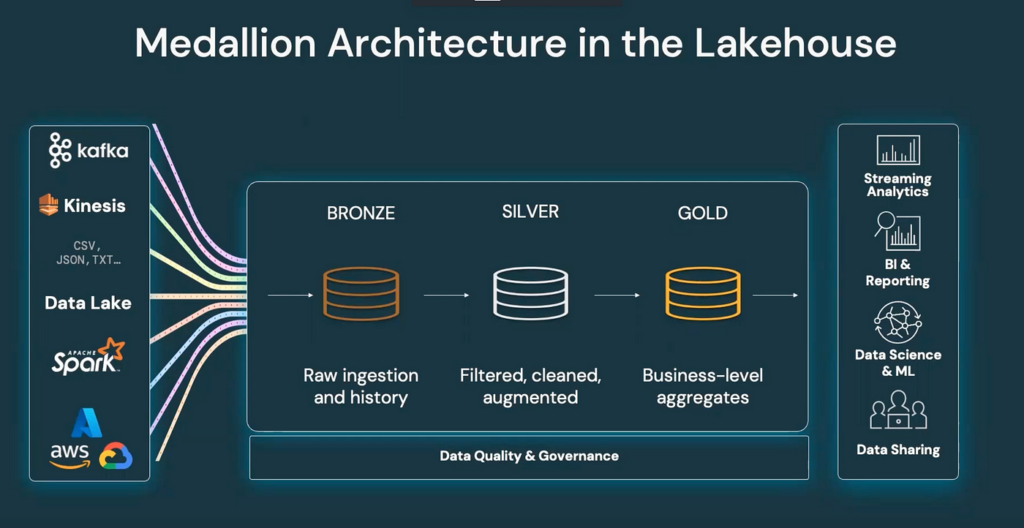
The three main layers are:
- Bronze layer
- Silver layer
- Gold layer
Each layer has a clear role. Together, they create a system where data flows from raw to refined.
This approach is widely used in Databricks because it aligns well with the lakehouse model and supports both batch and real-time data processing.
Why Business Leaders Should Care About Data Structure
Before going deeper into the layers, it is important to understand why this matters at a business level.
Many companies invest in dashboards and AI tools but still do not get reliable results. The problem is not the tools. The problem is the data behind them.
When data is not structured properly, it leads to:
- Inconsistent reports across teams
- Delays in decision-making
- High costs due to repeated work
- Low trust in data
Medallion Architecture solves this by creating a clear data flow and improving data quality at each stage.
For business leaders, this means:
- Faster and more reliable insights
- Better alignment across teams
- Reduced operational risk
- A strong foundation for AI
Understanding the Three Layers of Medallion Architecture
Bronze Layer: Raw Data
The Bronze layer is where all raw data is stored.
This includes data coming from different sources such as:
- Transaction systems
- IoT devices
- APIs
- Logs and event streams
At this stage, the data is stored as it is. It is not cleaned or transformed.
The goal of the Bronze layer is to capture everything.
This ensures that no data is lost and that there is a full history available for future use.
However, this data is not ready for analysis. It may contain errors, duplicates, and inconsistencies.
Silver Layer: Clean and Structured Data
The Silver layer is where data is cleaned and organized.
In this layer, the following steps are performed:
- Removing duplicates
- Fixing missing values
- Standardizing formats
- Validating data quality
The goal is to create a consistent and reliable dataset that can be used for analysis.
This layer is often used by data engineers and analysts who need clean data for reporting and modeling.
By separating this step from the raw data, organizations can ensure that the cleaning process is transparent and repeatable.
Gold Layer: Business-Ready Data
The Gold layer is where data is prepared for business use.
In this layer, data is transformed into formats that are easy to understand and use.
This includes:
- Aggregated data for reporting
- Business metrics and KPIs
- Data models for dashboards
- Inputs for machine learning models
The Gold layer is what business teams interact with. It provides clear and consistent data that supports decision-making.
At this stage, the data is ready to be used by tools such as BI dashboards, applications, and AI systems.
Quick link: Databricks for Energy Sector
How Medallion Architecture Works in Databricks
Databricks provides a strong foundation for implementing Medallion Architecture.
It allows organizations to build a lakehouse where all data layers exist in one platform.
In a Databricks environment:
- Data is ingested into the Bronze layer using pipelines
- Processing jobs transform data into the Silver layer
- Further transformations create the Gold layer
Databricks supports both batch and real-time processing, which means data can move through these layers continuously.
It also provides tools for data governance, monitoring, and scalability.
This makes it easier for organizations to manage large volumes of data while maintaining structure and quality.
Benefits of Medallion Architecture for Businesses
Medallion Architecture is not just a technical concept. It has clear business benefits.
Key benefits include:
- Improved data quality across all systems
- Faster access to reliable insights
- Reduced duplication of work
- Better alignment between teams
- Strong foundation for AI and analytics
When data flows through a structured system, it becomes easier to manage, scale, and trust.
Common Mistakes Companies Make
Many organizations try to implement modern data platforms but fail to get results.
This often happens because they skip the fundamentals.
Common mistakes include:
- Using raw data directly for reporting
- Mixing different data stages in one system
- Ignoring data quality issues
- Building dashboards without clear data models
These mistakes lead to confusion and inconsistent results.
Medallion Architecture helps avoid these problems by creating clear boundaries between data stages.
Real-World Example
Consider a company that tracks customer transactions.
Without a structured approach, the company may:
- Store raw transaction data in multiple systems
- Build reports directly on raw data
- Get different results across teams
With Medallion Architecture:
- All raw data is stored in the Bronze layer
- Clean and validated data is created in the Silver layer
- Business metrics are built in the Gold layer
This ensures that everyone works with the same data and gets consistent results.
Quick link: Why Tenplus Is #1 AI & Data Consulting Firm
Why Medallion Architecture Supports AI
AI systems depend on high-quality data.
If the data is inconsistent or incomplete, AI models will produce unreliable results.
Medallion Architecture ensures that data is clean and structured before it is used for AI.
This improves model accuracy and reduces errors.
It also makes it easier to scale AI systems across the organization.
How Tenplus Helps Implement Medallion Architecture
Implementing Medallion Architecture requires more than just tools. It requires a clear strategy and proper execution.
Tenplus helps organizations design and build data platforms that follow this structure.
The focus is on creating systems that are simple, scalable, and aligned with business goals.
Tenplus supports organizations by:
- Designing data architectures based on Medallion principles
- Building pipelines for data ingestion and transformation
- Ensuring data quality and governance
- Enabling analytics and AI on top of structured data
Tenplus also offers a free proof of concept, allowing companies to see how Medallion Architecture works in their environment before making larger investments.

Conclusion
Data is one of the most valuable assets for any organization. However, its value depends on how it is structured and managed.
Medallion Architecture provides a clear and practical way to organize data and improve its quality.
For business leaders, this means better insights, faster decisions, and stronger systems.
When combined with platforms like Databricks, it creates a powerful foundation for analytics and AI.
If you are looking to implement Medallion Architecture and build a scalable data platform, Tenplus can help you design and deliver a system that works in real-world conditions.
With a strong focus on data foundations and a free proof of concept, Tenplus helps organizations move from raw data to real business outcomes.
FAQs
What is Medallion Architecture?
Medallion Architecture is a data design approach that organizes data into Bronze, Silver, and Gold layers based on quality and readiness.
Why is Medallion Architecture important for businesses?
It improves data quality, ensures consistency, and supports better decision-making.
Can Medallion Architecture be used with Databricks?
Yes, it is commonly implemented in Databricks using the lakehouse model.
How does Medallion Architecture support AI?
It ensures that data is clean and structured, which improves the accuracy of AI models.
How can Tenplus help with Medallion Architecture?
Tenplus helps design and implement scalable data platforms using Medallion Architecture and offers a free proof of concept.


One Response