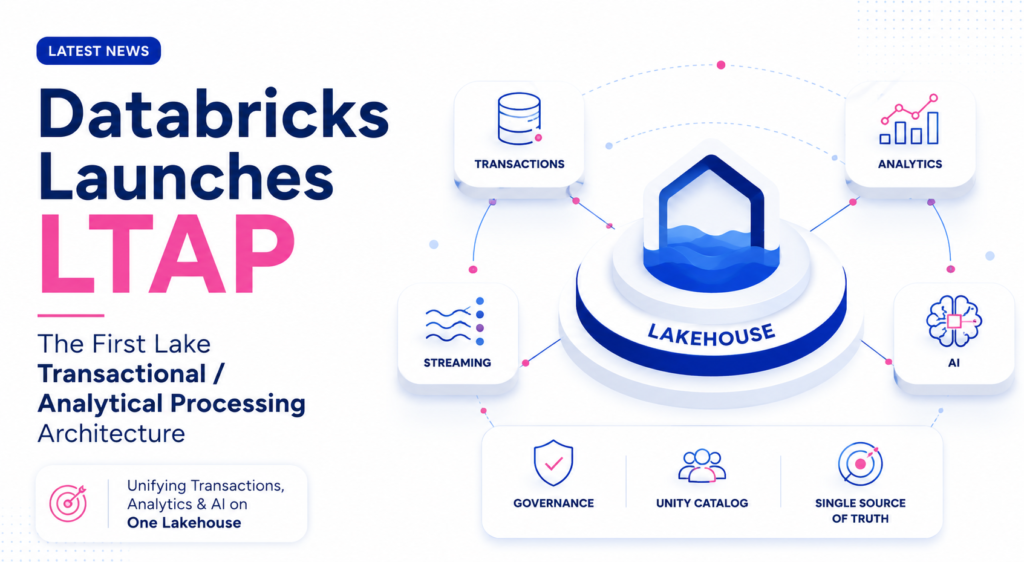
Databricks has announced one of its biggest architectural innovations since introducing the Lakehouse. At the Data + AI Summit 2026, the company unveiled Databricks LTAP (Lake Transactional/Analytical Processing), a new architecture designed to unify transactional processing, analytics, streaming, and AI workloads on a single governed copy of data.
For decades, organizations have maintained separate systems for operational transactions and business analytics. One database handled customer orders, financial transactions, or application data, while another platform was responsible for reporting, dashboards, and machine learning. Although this architecture became the industry standard, it also introduced complexity, duplicate data, expensive ETL pipelines, synchronization delays, and governance challenges.
Databricks LTAP represents a significant shift in how enterprise data platforms are designed. Instead of maintaining multiple copies of the same information across different systems, LTAP enables organizations to process operational and analytical workloads on a single governed data foundation. This approach aims to simplify architecture while making data immediately available for analytics and AI.
In this article, we explore what Databricks LTAP is, why it matters, how it works, and what it could mean for organizations investing in modern data platforms.
- What Is Databricks LTAP?
- Why Traditional Data Architectures Create Challenges
- How Databricks LTAP Changes the Architecture
- The Role of Lakebase in LTAP
- Key Benefits of Databricks LTAP
- Why LTAP Matters for AI Applications
- Potential Business Use Cases
- What Does This Mean for Existing Databricks Customers?
- Challenges Organizations Should Consider
- Why This Announcement Is Important for the Future of Data Platforms
- How Tenplus Helps Organizations Adopt Modern Databricks Architectures
- Conclusion
What Is Databricks LTAP?
Databricks LTAP stands for Lake Transactional/Analytical Processing.
It is a new data architecture that combines two traditionally separate worlds:
- Online Transaction Processing (OLTP)
- Online Analytical Processing (OLAP)
Historically, these workloads have required different technologies.
Operational applications needed fast transactional databases capable of processing thousands of updates every second, while analytical systems were designed to process massive datasets for reporting and business intelligence.
Databricks LTAP brings these capabilities together by allowing both workloads to operate on a single copy of governed data stored within the Lakehouse. Instead of continuously moving data between databases, organizations can work directly from one trusted data foundation.
Why Traditional Data Architectures Create Challenges
Most enterprise data platforms follow a familiar pattern.
An operational database stores business transactions.
Data is then copied into a warehouse or lake through ETL or ELT pipelines.
Analytics teams create dashboards from this second copy.
Machine learning teams often create yet another copy for model training.
Although this architecture works, it creates several challenges.
Multiple Copies of the Same Data
Every new pipeline creates another version of the same information.
Keeping these copies synchronized requires ongoing effort.
Delayed Analytics
Analytics teams often wait minutes, hours, or even days before transactional data becomes available.
This delay limits real-time decision-making.
Higher Infrastructure Costs
Running multiple databases, storage systems, and data pipelines increases infrastructure and operational costs.
Governance Complexity
Each platform requires its own security policies, permissions, auditing, and monitoring.
Managing governance across multiple systems becomes increasingly difficult as organizations grow.
How Databricks LTAP Changes the Architecture
Databricks LTAP introduces a unified architecture where transactional processing and analytics operate on the same governed storage layer.
Instead of continuously copying data between systems, organizations work with one authoritative version of the data.
According to Databricks, LTAP is designed to unify:
- Transaction processing
- Analytics
- Streaming data
- Operational workloads
- AI applications
This reduces the need for traditional ETL pipelines while making operational data immediately available for analytics and AI.

The Role of Lakebase in LTAP
One of the key technologies behind LTAP is Lakebase, the serverless PostgreSQL database introduced by Databricks.
Lakebase handles transactional workloads while remaining tightly integrated with the Databricks Lakehouse.
This allows operational applications to write transactional data while analytics, reporting, and AI workloads access that same governed data foundation without maintaining duplicate storage systems.
For organizations building AI-powered applications, this architecture reduces the complexity traditionally associated with synchronizing operational and analytical environments.
Key Benefits of Databricks LTAP
A Single Source of Truth
One of the biggest advantages of LTAP is reducing duplicate datasets.
Instead of maintaining separate operational and analytical databases, organizations work from one governed copy of information.
This improves consistency and reduces synchronization issues.
Faster Analytics
Since operational data no longer needs to be copied into another platform before analysis, reporting can happen much faster.
Businesses gain quicker visibility into customer activity, financial transactions, operational performance, and application usage.
Simplified Data Architecture
Many modern enterprise architectures contain dozens or even hundreds of pipelines that exist primarily to copy data between systems.
LTAP reduces this architectural complexity by minimizing unnecessary movement of information.
Better Governance
Because transactional and analytical workloads share the same governed foundation, organizations can apply consistent security, permissions, auditing, and governance policies across their entire environment.
This aligns closely with Databricks’ broader governance capabilities such as Unity Catalog.
Stronger AI Readiness
Modern AI systems require access to fresh, reliable data.
LTAP helps reduce delays between operational systems and AI models, allowing organizations to build applications that respond to current business events rather than yesterday’s data.
Why LTAP Matters for AI Applications
Artificial intelligence is changing how organizations build software.
Many AI applications require access to live operational data rather than historical snapshots.
Examples include:
- AI customer assistants
- Fraud detection
- Supply chain optimization
- Predictive maintenance
- Personalized recommendations
Traditional architectures often introduce delays because transactional data must first move through multiple pipelines before becoming available.
LTAP reduces this delay by making operational information immediately available within the Lakehouse architecture.
For organizations building agentic AI systems, this creates new opportunities for real-time intelligence.
Potential Business Use Cases
Databricks LTAP can benefit organizations across many industries.
Financial Services
Banks can combine transaction processing with fraud detection and risk analytics without waiting for separate ETL jobs.
Retail and E-commerce
Retailers can analyze customer purchases, inventory changes, and product recommendations using current operational data.
Manufacturing
Manufacturers can combine IoT sensor data, production systems, and operational analytics on one platform.
Healthcare
Healthcare providers can improve reporting and operational visibility while maintaining consistent governance.
Software Companies
Modern SaaS platforms can build AI-powered features using operational data that is immediately available for analytics and machine learning.
What Does This Mean for Existing Databricks Customers?
Organizations already using Databricks may benefit from a simpler architecture over time.
Rather than managing separate transactional databases, analytics platforms, and governance models, businesses can gradually move toward a more unified environment.
However, LTAP does not necessarily replace every existing database immediately.
Many organizations will adopt the architecture gradually while evaluating where it provides the greatest business value.
Migration strategies will depend on workload requirements, existing infrastructure, compliance obligations, and performance expectations.
Challenges Organizations Should Consider
Although LTAP introduces exciting possibilities, enterprises should approach adoption with careful planning.
Organizations should evaluate:
- Existing application architecture
- Transaction workloads
- Performance requirements
- Security policies
- Governance processes
- Migration strategy
Like any major architectural change, successful implementation requires thoughtful planning rather than simply adopting new technology.
Businesses should also consider how LTAP fits into their broader cloud strategy and long-term AI roadmap.
Why This Announcement Is Important for the Future of Data Platforms
The launch of Databricks LTAP signals an important shift in enterprise data architecture.
For years, organizations accepted that operational systems and analytics platforms had to remain separate.
Databricks is challenging that assumption by introducing an architecture designed to bring transactions, analytics, streaming, governance, and AI together on one platform.
If widely adopted, LTAP could reduce infrastructure complexity while helping organizations build faster, more intelligent applications.
As AI continues to move into business operations, architectures that reduce latency and eliminate unnecessary data movement are likely to become increasingly valuable.
How Tenplus Helps Organizations Adopt Modern Databricks Architectures
New technologies create exciting opportunities, but successful adoption depends on proper architecture, governance, and implementation.
The Tenplus team helps businesses:
- Design Lakehouse architectures
- Implement Databricks platforms
- Build scalable data engineering pipelines
- Deploy Unity Catalog for governance
- Optimize Databricks performance and costs
- Modernize enterprise data platforms
- Prepare environments for AI and machine learning
Rather than simply implementing new technology, Tenplus focuses on building practical data platforms that deliver measurable business value.
Whether your organization is evaluating Databricks LTAP, modernizing legacy systems, or building AI-ready data foundations, Tenplus can help develop a strategy that supports long-term growth.
Conclusion
The launch of Databricks LTAP represents one of the most significant announcements from the Data + AI Summit 2026. By combining transactional processing, analytics, streaming, and AI workloads on a single governed data foundation, Databricks is challenging decades of traditional enterprise architecture.
For organizations looking to simplify data platforms, reduce pipeline complexity, improve governance, and accelerate AI adoption, LTAP introduces an exciting new architectural direction.
As with any emerging technology, success depends on thoughtful planning and expert implementation.
If your organization is exploring Databricks LTAP, modern Lakehouse architectures, or enterprise AI platforms, Tenplus can help you evaluate, design, and implement a scalable solution that aligns with your business objectives.
What is Databricks LTAP?
Databricks LTAP (Lake Transactional/Analytical Processing) is a new architecture that combines transactional processing, analytics, streaming, and AI workloads on a single governed data foundation.
How is LTAP different from traditional data architectures?
Traditional architectures separate operational databases from analytics platforms. LTAP brings both workloads together on one governed copy of data, reducing the need for ETL pipelines and duplicate storage.
What is Lakebase in Databricks LTAP?
Lakebase is Databricks’ serverless PostgreSQL database that powers transactional workloads within the LTAP architecture while remaining integrated with the Lakehouse.
What are the benefits of Databricks LTAP?
Key benefits include a single source of truth, faster analytics, simplified architecture, stronger governance, and improved support for AI applications.
How can Tenplus help with Databricks LTAP?
Tenplus helps organizations design modern Databricks architectures, implement governance, optimize performance, and build AI-ready data platforms that support long-term business growth.