

Machine learning is becoming an important part of modern business operations. Companies use machine learning models to improve forecasting, automate decisions, detect risks, and understand customer behavior.
However, building a machine learning model is not just about writing code.
Many organizations struggle because their machine learning projects lack:
- Clean and structured data
- Scalable infrastructure
- Model tracking and monitoring
- Reliable deployment workflows
This often leads to models that work in testing environments but fail in real production systems.
This is where platforms like Databricks and MLflow become important.
Together, they help organizations build, track, deploy, and manage machine learning models more efficiently.
In this blog, we will explain how to build a machine learning model in Databricks using MLflow and why this approach is becoming important for modern AI systems.
- Why Machine Learning Projects Often Fail
- What Is Databricks?
- What Is MLflow?
- Why Databricks and MLflow Work Well Together
- Step 1: Prepare and Understand the Data
- Step 2: Explore and Analyze the Data
- Step 3: Split the Dataset
- Step 4: Train the Machine Learning Model
- Step 5: Track Experiments Using MLflow
- Step 6: Register and Manage the Model
- Step 7: Deploy the Model
- Step 8: Monitor Model Performance
- Benefits of Using Databricks and MLflow for Machine Learning
- Common Mistakes Companies Make
- Why Strong Data Foundations Matter
- How Tenplus Helps Organizations Build Machine Learning Systems
- Conclusion
- FAQs
Why Machine Learning Projects Often Fail
Many companies invest heavily in AI and machine learning but fail to see business value.
The reason is usually not the model itself.
The problem is often related to:
- Poor data quality
- Weak infrastructure
- Lack of scalability
- No model tracking process
- Difficulty deploying models into production
Machine learning systems depend heavily on the quality of the underlying data and workflows.
Without proper structure, even advanced models struggle to produce reliable outcomes.
What Is Databricks?
Organizations use Databricks to:
- Process large datasets
- Build data pipelines
- Run analytics
- Train machine learning models
- Support AI workflows
One of the main advantages of Databricks is that it combines:
- Data engineering
- Analytics
- Machine learning
- Governance
In a single platform.
This makes collaboration easier across data teams.
What Is MLflow?
MLflow is an open-source platform used for managing the machine learning lifecycle.
It helps organizations:
- Track experiments
- Manage models
- Store model versions
- Deploy models into production
MLflow simplifies machine learning operations and improves reproducibility.
Instead of manually tracking experiments and configurations, teams can manage everything in a structured way.
Why Databricks and MLflow Work Well Together
Databricks includes built-in support for MLflow.
This combination allows organizations to:
- Train models at scale
- Track experiments automatically
- Manage model versions
- Deploy models more efficiently
It creates a unified workflow where data, models, and experiments are managed in one environment.
This reduces operational complexity significantly.
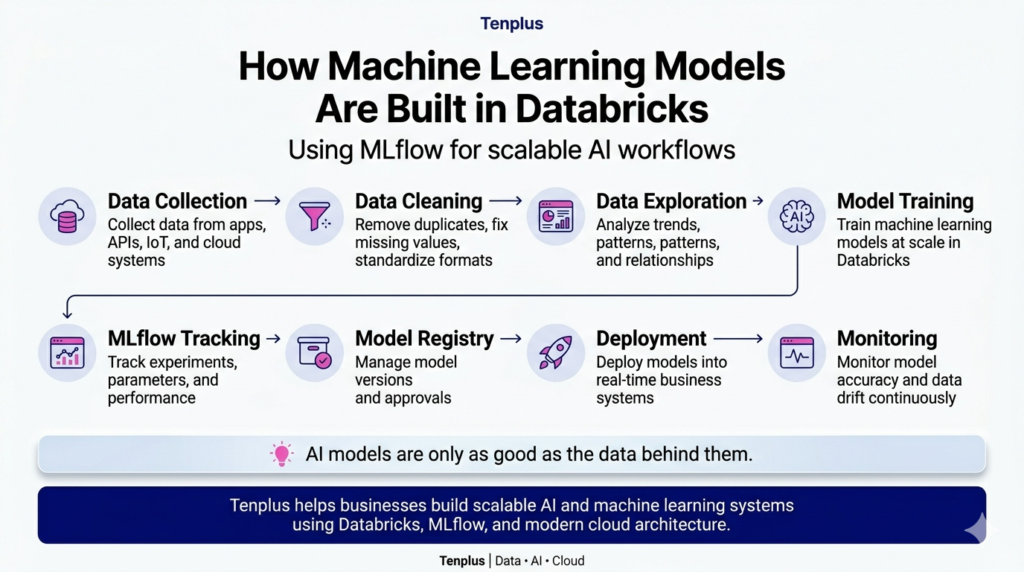
Step 1: Prepare and Understand the Data
The first step in building a machine learning model is preparing the data.
This is one of the most important steps.
Many machine learning projects fail because the data is incomplete, inconsistent, or poorly structured.
In Databricks, data is usually collected from:
- Databases
- APIs
- Cloud storage
- Streaming systems
- Business applications
Before training the model, the data must be:
- Cleaned
- Standardized
- Validated
- Structured properly
Common preparation tasks include:
- Removing duplicates
- Handling missing values
- Standardizing formats
- Filtering incorrect records
Good data quality improves model accuracy significantly.
Step 2: Explore and Analyze the Data
Once the data is cleaned, the next step is understanding it.
Data exploration helps identify:
- Trends
- Outliers
- Relationships between variables
- Potential issues in the dataset
Databricks notebooks allow teams to:
- Query data
- Create visualizations
- Analyze patterns
This step helps determine which features should be used in the machine learning model.
Step 3: Split the Dataset
Before training the machine learning model, the dataset is usually divided into:
- Training data
- Testing data
The training data is used to teach the model, while the testing data is used to evaluate performance.
This helps determine whether the model can perform well on unseen data.
Without proper testing, models may appear accurate but fail in real-world conditions.

Step 4: Train the Machine Learning Model
After preparing the data, the model training process begins.
Databricks supports multiple machine learning frameworks such as:
- Scikit-learn
- TensorFlow
- PyTorch
- XGBoost
During training, the model learns patterns from the data.
The choice of model depends on the business problem.
For example:
- Classification models are used for predictions like fraud detection
- Regression models are used for forecasting
- Clustering models are used for segmentation
Databricks provides scalable compute resources, allowing organizations to train models efficiently even on large datasets.
Quick link: 10 Common Databricks Mistakes
Step 5: Track Experiments Using MLflow
One of the biggest challenges in machine learning projects is experiment tracking.
Teams often test:
- Different algorithms
- Different parameters
- Different datasets
Without proper tracking, it becomes difficult to compare results.
MLflow solves this problem.
MLflow automatically tracks:
- Model parameters
- Metrics
- Training runs
- Performance results
This makes experimentation more organized and repeatable.
Teams can compare multiple versions of the model and identify which one performs best.
Step 6: Register and Manage the Model
Once a model performs well, it can be registered inside MLflow.
Model registration helps organizations:
- Store model versions
- Track updates
- Manage deployments
- Maintain governance
This is important because machine learning models evolve over time.
A structured model registry improves operational control and scalability.
Step 7: Deploy the Model
After validation, the model can be deployed into production.
Deployment allows applications and systems to use the machine learning model in real time.
For example:
- Fraud detection systems
- Recommendation engines
- Predictive maintenance systems
- Forecasting applications
Databricks and MLflow simplify deployment workflows by providing integrated deployment capabilities.
Step 8: Monitor Model Performance
Building the model is not the end of the process.
Machine learning models must be monitored continuously.
Over time:
- Data patterns change
- User behavior changes
- Business conditions evolve
This can reduce model accuracy.
Organizations should monitor:
- Prediction accuracy
- Drift in data patterns
- Operational performance
Monitoring ensures that the machine learning model continues delivering value over time.
Benefits of Using Databricks and MLflow for Machine Learning
Databricks and MLflow provide several important benefits for machine learning teams.
Scalability
Databricks can process large datasets efficiently and support large-scale model training.
Collaboration
Teams can work together in one environment, improving visibility and coordination.
Experiment Tracking
MLflow provides structured experiment management and version control.
Faster Deployment
Integrated workflows reduce the complexity of moving models into production.
Better Governance
Organizations can track model versions, changes, and performance more effectively.
Common Mistakes Companies Make
Many organizations struggle with machine learning projects because they focus only on the model.
Common mistakes include:
- Ignoring data quality
- Building models without governance
- Lack of monitoring after deployment
- No experiment tracking process
- Overengineering infrastructure too early
Successful machine learning systems require strong foundations, not just advanced algorithms.
Why Strong Data Foundations Matter
Machine learning models are only as good as the data behind them.
Without:
- Clean data
- Structured pipelines
- Reliable governance
Even powerful models fail to produce reliable outcomes.
This is why organizations should focus on:
- Data quality
- Architecture design
- Pipeline scalability
Before scaling AI systems.
How Tenplus Helps Organizations Build Machine Learning Systems
Building a machine learning model is not just about choosing algorithms.
Organizations need:
- Scalable infrastructure
- Reliable pipelines
- Governance processes
- Efficient cloud architecture
Tenplus supports organizations by:
- Building scalable data platforms
- Designing machine learning workflows
- Improving data quality and governance
- Optimizing cloud infrastructure
- Supporting real-time AI systems
The focus is always on practical implementation and long-term scalability.
Tenplus also offers a free proof of concept, allowing organizations to validate machine learning strategies before making larger investments.
Conclusion
Building a machine learning model in Databricks using MLflow provides organizations with a scalable and structured approach to AI development.
Databricks simplifies large-scale data processing and model training, while MLflow improves experiment tracking, deployment, and governance.
However, successful machine learning systems depend on more than just tools.
Organizations need:
- Strong data foundations
- Reliable pipelines
- Scalable architecture
- Clear governance processes
If your organization is exploring machine learning and AI initiatives, Tenplus can help you build systems that are scalable, reliable, and aligned with business goals.
With a practical approach and a free proof of concept, Tenplus helps organizations turn machine learning into real business value.
FAQs
What is a machine learning model?
A machine learning model is a system trained on data to identify patterns and make predictions or decisions.
What is MLflow used for?
MLflow is used to track experiments, manage models, and support machine learning deployment workflows.
Why use Databricks for machine learning?
Databricks provides scalable infrastructure, integrated workflows, and support for large-scale AI systems.
Can Databricks and MLflow work together?
Yes, Databricks includes built-in MLflow support for experiment tracking and model management.
How can Tenplus help with machine learning projects?
Tenplus helps organizations build scalable machine learning systems, improve data quality, and optimize AI infrastructure.




3 Responses