
Data has become one of the most valuable assets for modern businesses. Companies use data to understand customers, improve operations, reduce costs, and make better decisions.
However, as data grows, managing it becomes more difficult.
Many organizations struggle with:
- Slow reporting systems
- Data stored in different locations
- Poor scalability
- High infrastructure management effort
Traditional data warehouses were not designed for the scale and flexibility modern businesses need today.
In this beginner-friendly guide, we will explain what Snowflake is, how it works, why companies use it, and how it supports modern data and AI systems.
- What Is Snowflake?
- Why Snowflake Became Popular
- How Snowflake Works
- Key Features of Snowflake
- Common Use Cases of Snowflake
- Benefits of Snowflake for Businesses
- Snowflake vs Traditional Data Warehouses
- Common Challenges Companies Face With Snowflake
- Why Data Foundations Still Matter
- How Snowflake Supports Modern AI Systems
- How Tenplus Helps Organizations Implement Snowflake
- Conclusion
- FAQs
What Is Snowflake?
Snowflake is a cloud-based data platform designed for storing and analyzing data.
In simple terms, it allows organizations to:
- Store large amounts of data
- Run analytics quickly
- Share data easily
- Scale systems without managing infrastructure
Unlike traditional databases, Snowflake is built specifically for the cloud.
This means companies do not need to manage servers, hardware, or complex infrastructure manually.
Snowflake handles most of the heavy operational work automatically.
Why Snowflake Became Popular
Many organizations moved to Snowflake because traditional systems created several problems.
Older data platforms often struggled with:
- Limited scalability
- Slow performance with large datasets
- Complex infrastructure management
- Difficulty supporting modern analytics
As businesses generated more data, these limitations became more serious.
Snowflake solved many of these challenges by offering:
- Cloud-native architecture
- Easy scalability
- High performance
- Flexible storage and compute separation
This made it easier for organizations to modernize their data systems.
How Snowflake Works
To understand Snowflake, it helps to look at its core structure.
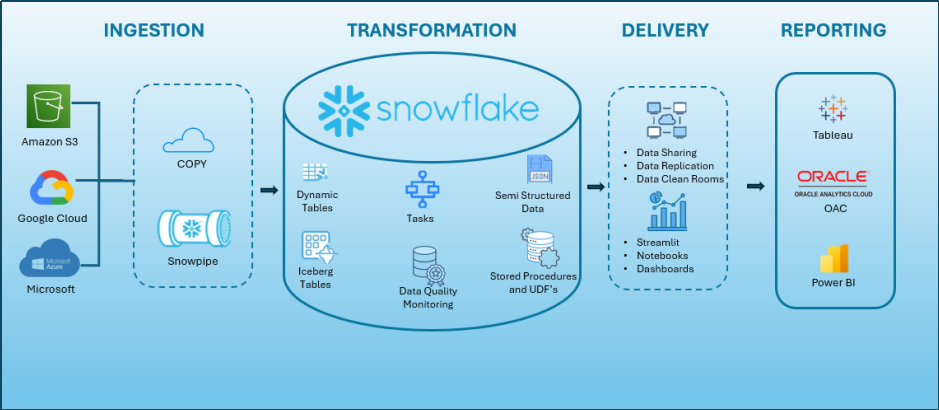
Snowflake separates three main layers:
- Storage
- Compute
- Cloud services
This design is one of the reasons it performs well at scale.
Storage Layer
The storage layer is where data is kept.
Snowflake automatically stores and organizes data in the cloud.
Users do not need to manage storage systems manually.
The platform handles:
- Compression
- Optimization
- Data organization
This simplifies data management significantly.
Compute Layer
The compute layer processes queries and workloads.
Snowflake uses virtual warehouses to handle compute tasks.
This means different teams can run workloads independently without affecting each other.
For example:
- Finance teams can run reports
- Analysts can query data
- Engineers can process pipelines
All at the same time.
This improves performance and reduces bottlenecks.
Cloud Services Layer
This layer manages:
- Security
- Metadata
- Authentication
- Query optimization
It acts as the coordination layer that keeps the platform running smoothly.
Quick link: Databricks vs Snowflake
Key Features of Snowflake
Snowflake includes several features that make it attractive for businesses.
Cloud-Native Architecture
Snowflake is designed specifically for the cloud.
It works across:
- AWS
- Microsoft Azure
- Google Cloud
This gives organizations flexibility in choosing cloud providers.
Separation of Storage and Compute
One of Snowflake’s biggest advantages is separating storage and compute.
This allows companies to:
- Scale compute independently
- Optimize costs
- Run multiple workloads simultaneously
This improves efficiency and flexibility.
Scalability
Snowflake can scale easily as data grows.
Organizations can increase resources when needed and reduce them during lower usage periods.
This helps manage costs more effectively.
Data Sharing
Snowflake makes it easier to share data securely between teams, partners, and customers.
Instead of moving large datasets manually, organizations can provide direct and controlled access.
Performance Optimization
Snowflake automatically optimizes many operations behind the scenes.
This reduces the need for manual tuning and improves query performance.
Common Use Cases of Snowflake
Snowflake supports many business use cases.
Business Intelligence and Reporting
Organizations use Snowflake to power dashboards and reports.
Teams can analyze:
- Sales performance
- Customer behavior
- Operational metrics
This improves decision-making across departments.
Data Warehousing
Snowflake is commonly used as a modern data warehouse.
It centralizes data from multiple systems into one scalable platform.
Data Engineering
Data engineers use Snowflake to:
- Build pipelines
- Process large datasets
- Transform data for analytics
AI and Machine Learning
Snowflake supports AI workloads by providing scalable access to structured data.
Clean and centralized data improves model performance.
Real-Time Analytics
Businesses use Snowflake for near real-time reporting and operational monitoring.
This helps teams react faster to changes.

Benefits of Snowflake for Businesses
Snowflake provides several important business benefits.
Easier Infrastructure Management
Organizations do not need to manage servers or hardware manually.
This reduces operational overhead.
Better Scalability
Snowflake can handle growing data volumes without requiring major architecture changes.
Faster Analytics
Teams can query large datasets quickly and generate insights faster.
Improved Collaboration
Different teams can work on the same platform while maintaining performance.
Cost Flexibility
Because compute and storage are separated, organizations can optimize resource usage more effectively.
Snowflake vs Traditional Data Warehouses
Traditional data warehouses were designed before cloud computing became common.
As a result, they often struggle with:
- Scalability
- Flexibility
- Infrastructure management
Snowflake solves many of these problems through its cloud-native design.
Traditional systems often require:
- Manual scaling
- Hardware management
- Long setup processes
Snowflake provides:
- Automatic scaling
- Managed infrastructure
- Faster deployment
This makes Snowflake easier to manage for modern businesses.
Common Challenges Companies Face With Snowflake
Although Snowflake is powerful, companies can still face challenges during implementation.
Poor Data Structure
Moving bad data into Snowflake does not improve quality automatically.
Without proper structure:
- Reports become inconsistent
- Analytics become unreliable
- AI models perform poorly
Cost Management Issues
If workloads are not optimized properly, cloud costs can increase quickly.
This often happens because of:
- Large queries
- Poor warehouse management
- Duplicate processing
Lack of Governance
Without governance, teams may create duplicate datasets and inconsistent reporting.
Why Data Foundations Still Matter
One important thing many companies misunderstand is this:
Snowflake is a platform, not a solution by itself.
The platform works best when organizations build:
- Strong data models
- Clear governance
- Efficient pipelines
Without these foundations, even modern platforms struggle to deliver reliable outcomes.
Tools are important.
Structure is more important.
How Snowflake Supports Modern AI Systems
AI systems depend heavily on clean and accessible data.
Snowflake helps support AI by:
- Centralizing data
- Improving scalability
- Enabling fast analytics
This makes it easier for organizations to build machine learning workflows and analytics pipelines.
However, AI success still depends on data quality and architecture design.
How Tenplus Helps Organizations Implement Snowflake
Implementing Snowflake successfully requires more than setting up a platform.
Organizations need:
- Strong data architecture
- Efficient pipelines
- Governance processes
- Cost optimization strategies
Tenplus supports organizations by:
- Designing scalable data platforms
- Building efficient pipelines
- Improving governance and data quality
- Optimizing cloud costs
- Enabling AI-ready architectures
The focus is always on building systems that are practical, scalable, and aligned with business goals.
Tenplus also offers a free proof of concept, allowing companies to validate solutions before making larger investments.
Conclusion
Snowflake has become one of the leading cloud data platforms because it simplifies how organizations store, manage, and analyze data.
Its cloud-native architecture, scalability, and flexibility make it a strong choice for modern analytics and AI systems.
However, successful implementation depends on more than the platform itself.
Organizations still need strong data foundations, governance, and architecture design to get real value from Snowflake.
If you are exploring Snowflake for your business, Tenplus can help you design and implement scalable data systems that support long-term growth and real business outcomes.
With a practical approach and a free proof of concept, Tenplus helps organizations turn data into clear and actionable systems.
FAQs
What is Snowflake used for?
Snowflake is used for storing, managing, and analyzing large amounts of data in the cloud.
Is Snowflake a database or a data warehouse?
Snowflake is a cloud-based data platform commonly used as a modern data warehouse.
Why is Snowflake popular?
Snowflake is popular because it is scalable, cloud-native, and easier to manage than traditional systems.
Can Snowflake support AI and analytics?
Yes, Snowflake supports analytics and AI workloads by providing scalable access to centralized data.
How can Tenplus help with Snowflake implementation?
Tenplus helps organizations design scalable architectures, optimize pipelines, and build AI-ready data systems using Snowflake.


2 Responses